| Key Takeaways |
|---|
| • Standing water almost always points to a drainage problem, from overwatering and compacted soil to poor grading. • Quick fixes like aerating and reducing watering handle minor pooling; low spots and chronic wet areas need regrading or a drain. • Don't ignore it. Standing water breeds mosquitoes in about a week and stresses your foundation. |
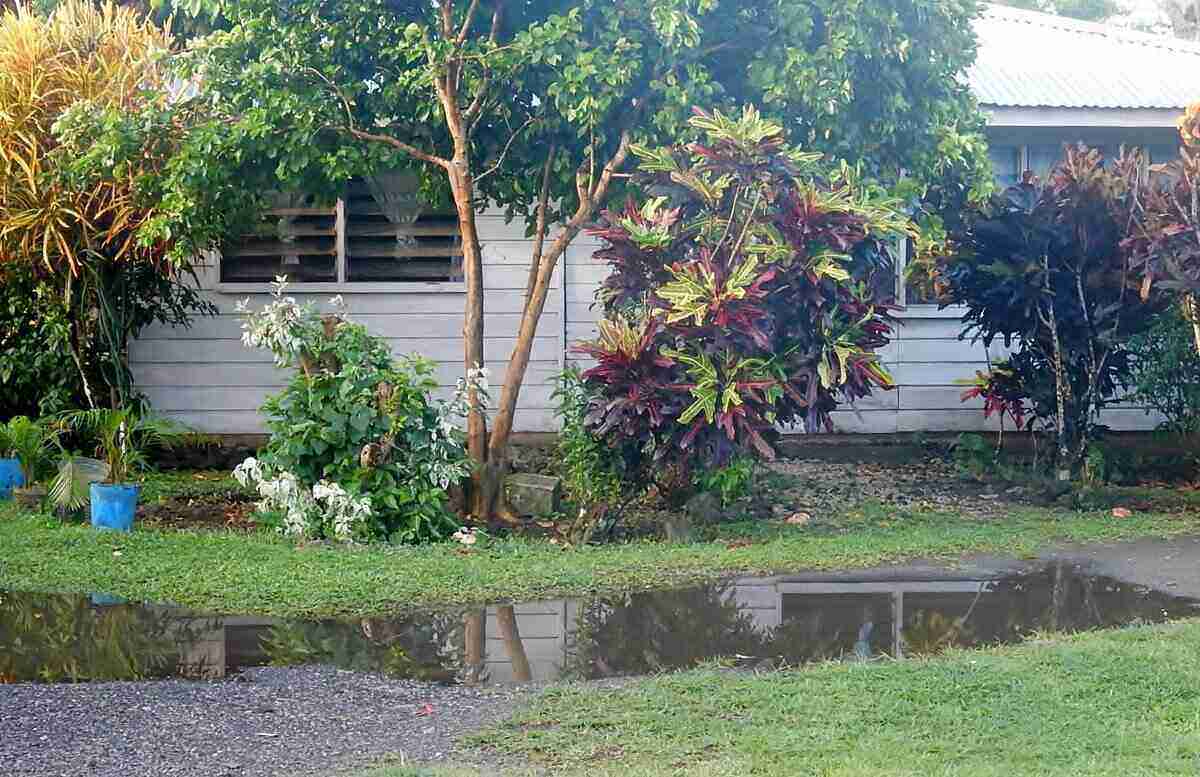
Pooling and standing water in your yard won’t fix itself. The cause is almost always poor drainage, and there’s a targeted fix for every problem.
This guide walks you through 9 ways to get rid of standing water in your yard for good, from aerating and regrading to French drains. It also covers what causes a yard that holds water and why it matters.
If you’d rather hand the wet, mucky work to someone else, a local Lawn Love pro can diagnose the drainage problem and solve it for good.
9 ways to get rid of standing water in your yard
Even if your area gets a lot of rain, your yard should drain within a day. When it doesn’t, the cause is almost always one of these 3 causes:
- Improper watering techniques
- Drainage problems with your soil
- Low spots in your landscape
The 9 methods below address all these issues. As Femeena Pandara Valappil, assistant professor of agricultural and biological engineering at Penn State, puts it: “The best solution ultimately depends on the source of the water and the site’s soil and drainage characteristics.”
1. Check for broken pipes
Try this if: water appears suddenly with no rain or irrigation
You may hear water flowing, which is a sure sign it’s not a drainage issue. An even better tell is a sudden spike in your water bill.
If the root problem is plumbing, none of the following solutions will permanently eliminate standing water. The water will keep coming back until you find the broken pipe and fix it.
To check whether the leak is from your irrigation system, disconnect it from the water supply. If the puddle stops growing and the trickling sound stops, contact an irrigation or landscaping company. A professional plumber should handle any other pipe leaks.
2. Water wisely
Try this if: water puddles in your lawn or driveway even when it hasn’t rained recently
Improper watering is often the culprit behind pooling and standing water in your yard. It could be linked to a subpar watering routine, improperly maintained sprinklers, or the wrong sprinkler system for your yard.
Turfgrass likes deep but infrequent watering. Exactly how often and how much depends on your grass type, soil type, local rainfall, and the season.

- Warm-season grasses need more water in summer than spring or fall.
- Cool-season grasses need the most in spring and fall, when they actively grow.
An inch of water per week is a good rule of thumb, but factor in rainfall. A full inch means you can skip watering that week. If you get less than that, hold off for a few days, then water enough to make up the difference.
Signs you’re overwatering your lawn include:
- A spongy feeling underfoot that lasts for hours after watering
- Fungal disease (webbing, dead patches, or oddly colored spots)
- Lots of weeds or mushrooms
- Yellowing grass
To measure your sprinkler’s output, use the catch-can test described by UF/IFAS Extension:
- Place at least 10 empty tuna cans (or cans of the same size) within one zone of your sprinkler system.
- Run the zone for 15 minutes.
- Measure the water depth in each can with a ruler, then average the readings.
- Repeat with each zone.
Use the table below to determine how many minutes to run a specific zone each week. You may need to run zones for different lengths of time, based on the type of sprinkler in each one.
| Average water depth after 15 minutes | Total minutes needed to water 1 inch/week |
| ⅛ inch | 120 |
| ¼ inch | 60 |
| ½ inch | 30 |
| ¾ inch | 20 |
| 1 inch | 15 |
Pro tip: Before finalizing an automated schedule, watch your lawn for a few weeks. Water only when you see signs of thirst (wilted, curled, or browning blades). Note how often you water on average, and build your schedule from there.
3. Dethatch and aerate your lawn
Try this if: water isn’t soaking into your soil even after minimal watering
Sometimes the problem isn’t how much you’re watering; it’s what is happening at and just below the soil surface. In many cases, thatch buildup and compacted soil are keeping water from soaking in.
Thatch is a tightly woven layer of grass stems, roots, and leaves that lies on the soil surface, just beneath the blades. A little is healthy and makes grass more resilient, but too much keeps water from seeping into the ground.
How to tell if it’s time to dethatch:

- Cut out a small triangle of turf 6 inches deep.
- Squeeze the spongy layer above the soil and measure it.
If it’s more than half an inch thick, it’s time to dethatch your lawn.
Compacted soil — usually caused by foot traffic — slows drainage just as much as thatch and starves your grass. Lawn aeration loosens the soil and opens space for water and nutrients to move through.
How to tell if it’s time to aerate:
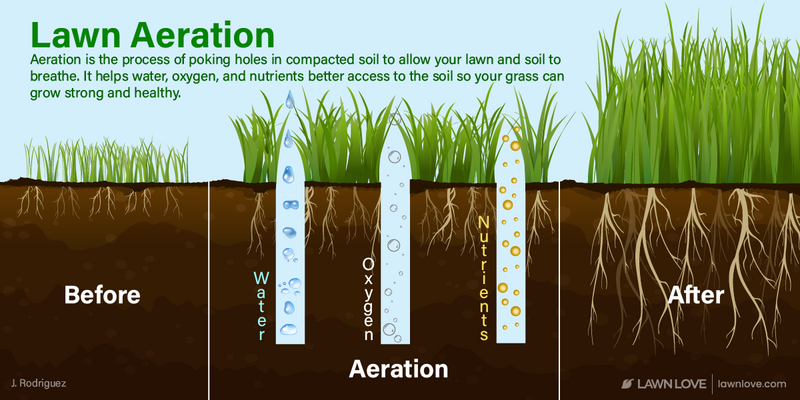
- Press a screwdriver into the ground.
- If it won’t go in or takes excessive force, your soil is likely compacted, and you should aerate your lawn.
My tip: Test a few different spots before assuming your soil is compacted. One failed screwdriver test could mean you hit a rock, or there’s another obstacle in the way.
Read more:
- Do I Need to Aerate or Dethatch My Lawn? (Simple Test)
- Can You Dethatch and Aerate at the Same Time?
4. Add compost to the soil
Try this if: water puddles in your yard even when you’re watering correctly, and you’ve already dethatched and aerated
Your soil type could be the cause. The 3 most common types are loam, sand, and clay. Water moves quickly through sand and loam but struggles through clay, which traps water and leaves it sitting on the surface.
Topdress with 2 to 3 inches of compost to break up the clay and help water move through faster. You also can add soil conditioners like expanded shale or humic acid. These amendments loosen tightly packed clay particles, creating small pore spaces that let water penetrate.
Jennifer Schutter, horticultural field specialist with the University of Missouri Extension, says don’t add sand on top of clay.
“Never use sand when amending clay soil as it creates a hard, brick-like texture. The clay acts like glue, binding the sand particles together, similar to concrete.”
5. Add a drainage system
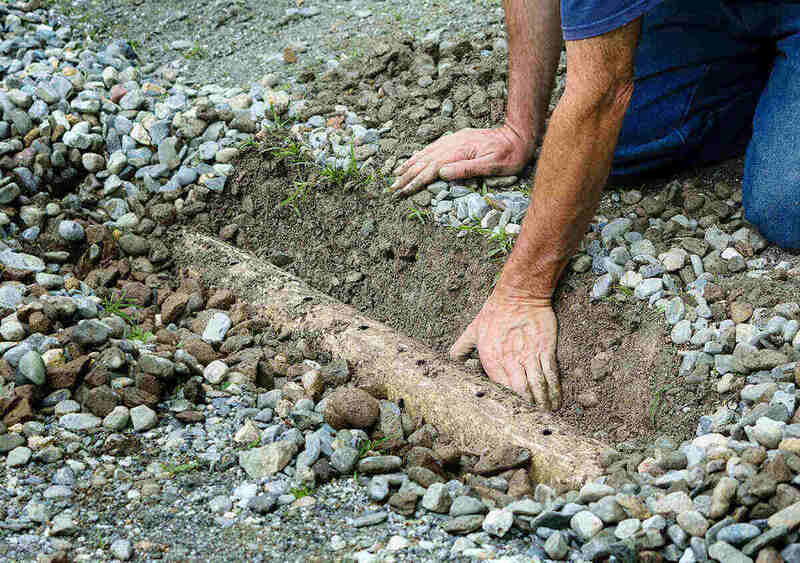
Try this if: your lawn is improperly graded or has a low slope
Sometimes the shape of your landscape calls for a more intensive solution. A drainage system either channels water to an appropriate outlet (a French drain) or sends it deep into the ground (a dry well).
French drainage systems
A French drain is a gravel-filled trench with a perforated pipe that runs from where water pools to an exit point — a dry well, rain garden, or storm drain. Landscaping fabric keeps soil and silt out, and the whole thing is covered with topsoil.
Dry wells
A dry well is a deep hole with a perforated, water-catching container surrounded by rocks. Water drains through the container and rocks into the soil. Dry wells make great termination points for French drains or sit beneath downspouts, especially in high-rainfall areas.
Dry wells must be installed a specific distance from your foundation, property lines, and septic fields. Check local building codes and environmental regulations for your area.
6. Regrade your yard (and fill low spots that collect water)
Try this if: water collects in low spots or you have a severely sloped yard
If your landscape slopes, water will naturally flow downhill and pool at the bottom. When the water runs toward your house, it becomes especially problematic since it can collect against the foundation.
The standard defense is to grade your yard properly. The International Association of Building Inspectors explains that building code requires you to slope the soil about 6 inches down, over the first 10 feet away from the house. This slope encourages water to run away from the foundation.
Away from the house, you can eliminate slopes if you aren’t purposely sloping the ground toward drainage systems or rain gardens. Leveling makes a yard flat and even, eliminating low spots that collect water.
My experience: I’ve filled in the low spots and used a lawn roller to correct a mildly uneven lawn. But for severe problems, especially grading around the foundation, call a pro. It often requires ripping out landscaping and using a mini excavator to move dirt.
7. Take care of gutters and downspouts
Try this if: you see water along the sides of your house or water sitting inside your gutters
Clogged gutters can’t do their job. When water can’t flow through them, it spills over the side or up onto your roof. You then risk damage to your roof, foundation, and siding. Clean gutters in autumn after the leaves fall, and in spring for bird nests and pine needles.
Downspout placement is another culprit. They should end at least 4 feet from your home if you have sandy soil, and 8 to 10 feet for dense clay soils. This extension allows water to drain away rather than pool against the foundation.
To extend them:
- Aluminum extensions are cheap and snap onto the existing downspout
- Splash blocks sit on the ground beneath the downspout to carry water away
- Roll-out drain sleeves uncoil in heavy rain and roll back up when it ends
Need help with gutter cleaning? A Lawn Love pro can help.
8. Build a rain garden
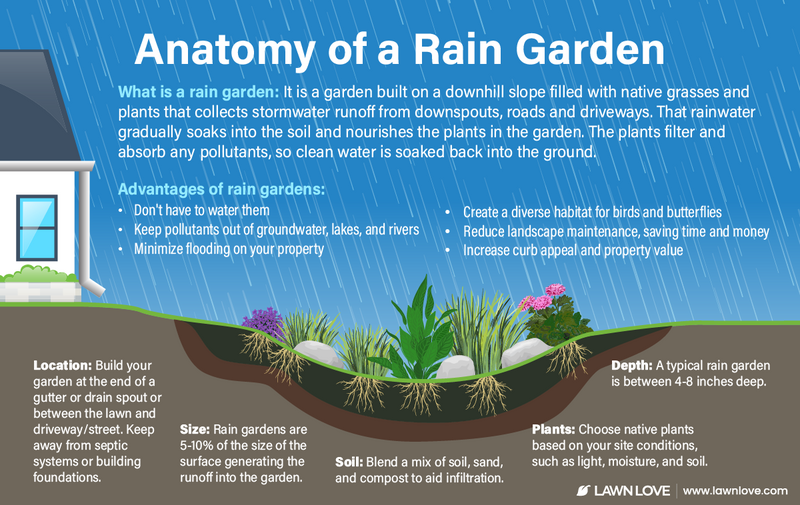
Try this if: a slope in your yard funnels rainwater into a low spot
Jodi Sulpizio, natural resources educator and master watershed steward coordinator at Penn State Extension, says rain gardens help in many ways while managing runoff.
“Rain gardens should be designed to capture stormwater runoff to help reduce localized flooding, improve water quality, recharge groundwater, and provide habitat for pollinators and wildlife,” she says.
Beyond managing runoff, a well-placed rain garden filters pollutants before they reach nearby waterways and may even qualify for a government rebate.
Sulpizio notes that “a lawn area that has a standing water issue is not a good location for a rain garden,” because “water that is ponded over 24-48 hours indicates a soil drainage issue.” Instead, build the garden upslope, where it can intercept runoff before it collects.
To determine whether a spot is viable for a rain garden, conduct a percolation test to ensure adequate drainage. Here’s how:
- Dig a hole 10 inches deep and fill it with water
- If the water disappears within 48 hours, the site is suitable
If the water doesn’t drain, test a different site.
“A rain garden must be able to infiltrate water within that 24-48 hour timeframe. Otherwise, the plants will not survive the inundation,” Sulpizio says.
A spot that never fully drains may be better suited for bog plants, which are adapted to handle prolonged standing water.
Valappil says rain gardens are “most effective at reducing localized flooding when runoff comes from relatively small drainage areas, such as rooftops, driveways, or lawns.”
When choosing plants, look for native flowers, shrubs, and ornamental grasses suited to wet areas. Sedges, rushes, and grasses are good choices thanks to their deep, complex roots. Due to the runoff issue, skip seeds and use plants with an established root system.
9. Use permeable hardscaping
Try this if: pooling water is concentrated on hardscaped areas
Concrete, cement, and asphalt are common materials in hardscaping projects, but they don’t allow water to reach the soil. With nowhere to go, rainwater and irrigation collect on the surface and can pick up pollutants as they pool.
The fix is to swap in permeable materials. Pavers, gravel, and stepping stones all let water filter into the ground, preventing pooling and runoff. You can also install a drain or maintain an existing one.
Why you should get rid of standing water

Water may be the source of life, but standing water can be a source of disease, struggling grass, and an unstable foundation. Here’s what’s at stake.
How standing water impacts your house
When water builds up along the sides of your house, it creates hydrostatic pressure against the foundation. As it evaporates during dry spells, that pressure releases.
The repeated push-and-release stresses the structure, leading over time to cracks, leaks, and an unstable foundation. This is why proper grading matters.
Excess water can also damage drywall and cause wooden structures to swell and warp, shortening their lifespan.
How standing water impacts your lawn
A soggy lawn is a recipe for bald spots and disease. Consistently wet grass invites fungal diseases like dollar spot, fairy ring, and red thread.
These diseases are tough to beat because fertilizer makes them worse. If you stop fertilizing to treat the disease, you end up with nutrient-starved, struggling grass. Fight back at the source by improving drainage before disease takes hold.
Other wet lawn problems include:
- Weeds
- Pest infestations
- Erosion
- Nutrient deficiencies
- Runoff
- Ineffective lawn treatments
How standing water impacts you
Standing water is a breeding ground for bacteria that can harm you, your family, and your pets. It’s also a prime mosquito nursery.
Mosquitoes can go from egg to biting adult in as little as 7 to 10 days, which is why the CDC recommends emptying or “tipping and tossing” anything that holds water at least once a week. Beyond the nuisance, mosquitoes can carry serious pathogens like Zika and West Nile virus.
FAQs
Yes. Gravel itself doesn’t absorb water, but the gaps between the rocks provide an easy path for water to trickle through, unlike tightly packed soil. That space holds water until the surrounding soil can take it in.
Use ½ inch to 3 inches of gravel in poorly drained areas.
The best water-absorbing groundcovers tolerate wet sites. Good options include:
Daylily (Hemerocallis spp.)
Globeflower (Trollius x cultorum)
Liriope (Liriope spp.)
Primrose (Primula spp.)
Violet (Viola spp.)
Prioritize native plants wherever possible. They benefit the local ecosystem and are easier to care for since they’re adapted to your climate and soil.
It depends on the type. Organic mulches like wood chips, bark, and straw absorb water. Inorganic mulches like rocks, gravel, and rubber don’t absorb water, but allow water to drain through the gaps.
For drainage specifically, inorganic mulch is usually the safer, more effective choice.
Get the proper lawn care
Getting rid of standing water is just the first step to a healthy lawn, as every part of lawn care feeds the next. Proper mowing means fewer weeds, which builds denser grass, which prevents erosion, which keeps nutrients in the soil.
Staying on top of maintenance also makes it easier to catch problems early and trace them to the source. If that sounds like a lot, Lawn Love can connect you with a local pro to maintain your landscape, fix drainage issues, and handle seasonal cleanup.
Get a free estimate near you →
Main Image: Standing water pools along a curb in front of a home surrounded by tropical landscaping. Photo Credit: Michael Coghlan / Flickr / CC BY-SA 2.0
Related Posts: